
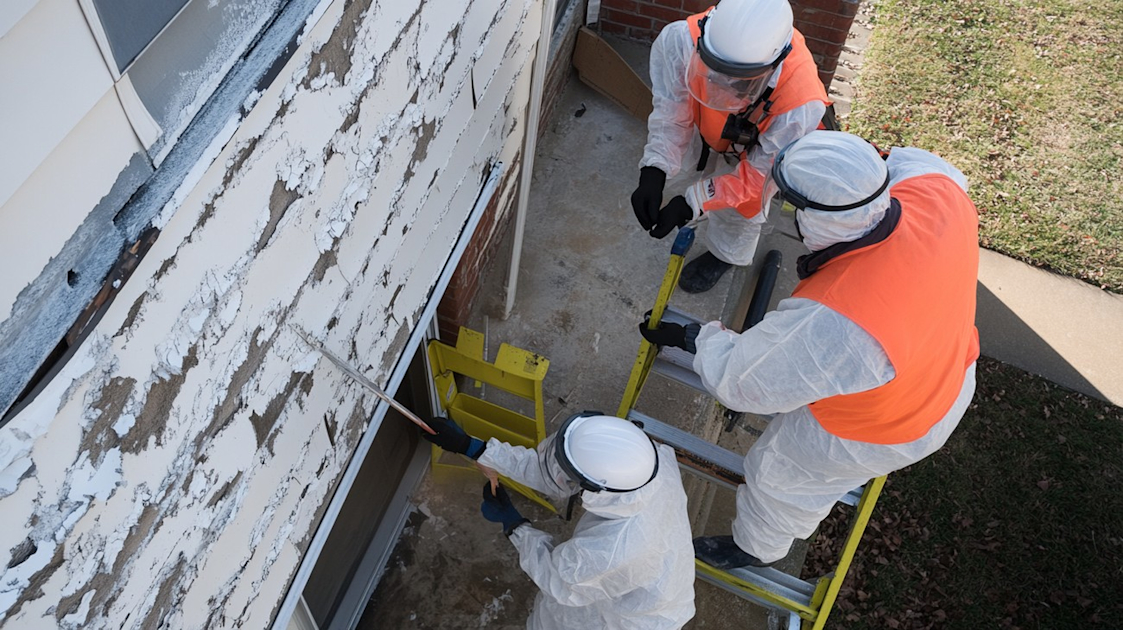


If your house has cement siding that might contain asbestos, have it tested before anyone cuts, breaks or removes it. In most of the Bay Area, asbestos in renovation work is regulated by the Bay Area Air Quality Management District's Regulation 11, Rule 2, which specifically requires sampling and testing before cement siding is removed or disturbed on homes with four or fewer units. If the siding contains asbestos and the job is large enough, removal has to be done by a contractor registered with Cal/OSHA for asbestos work, and the Air District has to be notified in advance. After abatement, the house is re-sided like any other.
This article explains the rules in plain terms. It is not legal advice; the agencies linked below have the final word on your project.
How to recognize asbestos-cement siding
Asbestos-cement siding was made by mixing asbestos fibers into cement and pressing it into shingles or panels. It turns up on houses built or re-sided between roughly the 1920s and the 1970s. Common signs:
- Rigid shingles or flat panels, often with a stamped wood-grain or dimpled texture that repeats from piece to piece
- A hard, brittle feel. A broken edge looks gray and cement-like rather than splintered like wood
- Several coats of paint on a material that has never rotted
None of these signs is proof. Modern fiber cement siding looks similar, and the U.S. EPA notes that you generally can't tell whether a material contains asbestos just by looking at it. A lab test is the only way to know. EPA also advises leaving asbestos material in good condition alone and not sawing, sanding, scraping or drilling it.
Who regulates asbestos siding removal in the Bay Area
| Agency | What it covers | What it means for a siding job |
|---|---|---|
| Bay Area Air Quality Management District (now branded the Bay Area Air District), Regulation 11, Rule 2 | Asbestos in demolition and renovation, notifications, work practices, waste handling | Testing before cement siding is disturbed; advance notice for larger removals; wetting and disposal rules |
| Cal/OSHA (Division of Occupational Safety and Health) | Worker protection and contractor registration | Contractors doing asbestos work involving 100 sq ft or more must be registered with DOSH |
| Contractors State License Board | Contractor licensing | Asbestos work of 100 sq ft or more needs a C-22 asbestos abatement license or the CSLB asbestos certification |
| Local building department | Building permit for the re-side | Permit, inspections and the new wall assembly |
The Air District covers Alameda, Contra Costa, Marin, Napa, San Francisco, San Mateo and Santa Clara counties, plus southern Sonoma and southwestern Solano. Northern Sonoma and the rest of Solano County fall under other air districts with their own rules.
What Regulation 11, Rule 2 requires on a house
The rule treats asbestos-cement products as Category II nonfriable material: when dry and intact, it can't be crumbled by hand. It becomes regulated asbestos-containing material when it is likely to be crumbled or pulverized during the work, which is what happens when siding is broken, cut or ground off a wall. The points that matter most for a homeowner:
- Testing is required for cement siding. For buildings with four or fewer dwelling units, a full asbestos survey is not required, but a sample and test is required when cement siding or stucco (among a few other materials) will be removed or disturbed.
- Notification for larger removals. The Air District must be notified at least 10 working days before a renovation that removes 100 square feet or more of regulated asbestos material. For single-family homes and buildings with up to four units, an extra fee allows a 72-hour start instead.
- Work practices and disposal. Regulated material has to be kept wet, handled to prevent emissions, and taken to a disposal site that accepts asbestos waste.
- Owner work. Some provisions, such as the on-site trained supervisor requirement, do not apply when owners remove material from their own owner-occupied single-family home. That is not a general exemption, and doing the work yourself still carries real health risk.
The Air District's asbestos program page lists the current notification thresholds and fees. Confirm the details with the District before work starts.
Cal/OSHA and contractor requirements
Under California's Labor Code and Title 8 rules, any employer or contractor doing asbestos-related work involving 100 square feet or more of material containing more than 0.1 percent asbestos must be registered with Cal/OSHA's Division of Occupational Safety and Health before the work starts. The contractor also needs either the CSLB's C-22 asbestos abatement classification or its asbestos certification. Siding on even a small house exceeds 100 square feet, so in practice a whole-house removal of asbestos-cement siding is a job for a registered abatement contractor.
A siding contractor without that registration should not remove asbestos siding. The usual arrangement is that a registered abatement company removes and disposes of the asbestos siding, then the siding contractor takes over to repair the wall and install the new cladding. When you hire, ask each contractor for their DOSH registration and CSLB license class, and check both. Our list of questions to ask a siding contractor covers the rest.
Your options
1. Abate, then re-side
The abatement contractor removes the asbestos siding under the required controls. The wall is then open, so the sheathing and weather barrier can be inspected and repaired, windows can be flashed properly, and new siding goes on a sound wall. This is the cleanest long-term outcome and the only option that removes the asbestos from the house.
2. Leave it in place and maintain it
Asbestos-cement siding in good condition is durable. If it is intact and you aren't planning other exterior work, repairing damaged pieces through an abatement contractor and repainting may be reasonable for now. The Air District defines an encapsulant as a sealant, such as latex paint, that coats the material; paint helps hold the surface together but does not remove the asbestos.
3. Cover it with new siding
Some owners install new siding over sound asbestos-cement siding. Fastening new siding means nailing or screwing through the old material, so whether this counts as disturbing it, and what precautions apply, is a question for the abatement consultant and the Air District before work begins. Covering it also hides the condition of the wall behind, and the asbestos is still there for the next owner or renovation. Check what your building department allows and what the new siding manufacturer requires.
What drives the cost
We don't publish prices, and asbestos jobs vary more than most. The main drivers:
- Testing. Sampling and lab analysis come first.
- Quantity and condition. More square footage, and siding that is already broken or crumbling, mean more containment and labor.
- Access. Two-story walls, hillside lots and tight side yards slow the work and need more staging.
- Notification and disposal. Air District fees (including the fee for a 72-hour start) and asbestos waste disposal are separate costs.
- What is under it. Once removed, the sheathing and weather barrier are exposed. Repairs found there are part of the re-side.
- Other hazards. Homes old enough for asbestos siding often have lead-based paint as well. On pre-1978 homes, the re-side has to follow lead-safe practices too.
- The new siding. Material, trim and windows drive the rest. See our siding replacement cost guide.
A sensible order of operations
- Have suspect siding sampled and tested before any exterior work is planned in detail.
- If it is positive, get bids from registered abatement contractors and confirm who handles Air District notification.
- Get a siding bid that starts where abatement ends: sheathing repair, weather barrier, flashing, new siding and trim.
- Coordinate the schedule so the wall is not left open to weather between the two contractors.
Stucco on older homes raises the same question; our Hardie vs stucco comparison covers replacing stucco. When you are ready, we can walk the house, coordinate with your abatement contractor, and give a free written estimate for the re-side. See our siding replacement page for how we work.
Frequently asked questions
How do I know if my siding contains asbestos?
Only a lab test can tell you. Rigid cement shingles or panels with a repeating stamped texture on an older house are a reason to test, but modern fiber cement looks similar. Have a qualified professional take the sample.
Is asbestos siding dangerous?
Intact asbestos-cement siding is generally considered low risk because the fibers are bound in cement. The risk comes from breaking, cutting, sanding or drilling it, which can release fibers. That is why testing and controlled removal are required before renovation.
Can I remove asbestos siding myself in the Bay Area?
Air District rules apply to owners as well as contractors, including testing, notification for larger removals, wetting and disposal. A few provisions are relaxed for owners working on their own single-family home, but the health risk is real. Hiring a registered abatement contractor is strongly recommended.
Can you put new siding over asbestos siding?
Sometimes, but fastening through the old siding may disturb it, and the asbestos stays in the wall. Ask your abatement consultant, the Air District and your building department before choosing this route.
What does asbestos siding replacement cost?
It depends on the amount of siding, its condition, access, disposal and the new siding chosen. Abatement and re-siding are usually priced separately by two contractors. Get a written abatement bid and a written re-side bid for the same scope.
Sources
The information provided here is intended for general reference and should not be considered professional advice. Before starting any project, consult a licensed contractor. Product features, specifications, and warranties may have been updated since this was published. Any mention of brands or products reflects personal opinion and does not constitute an endorsement or warranty.